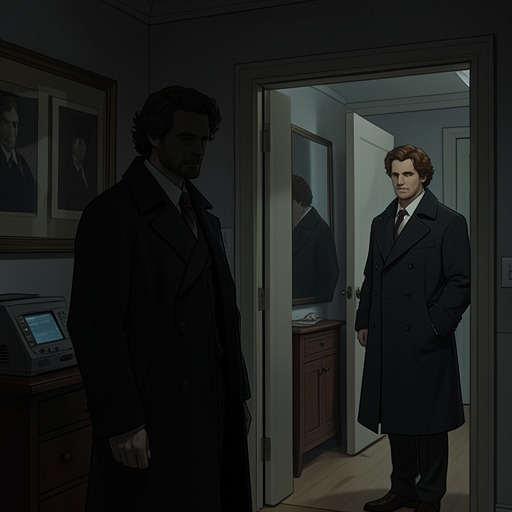
Dual identity and doublethink
The SympathizerDual identity and doublethink are central to the unnamed narrator’s life as a covert revolutionary embedded in the South Vietnamese establishment. His divided loyalties are not merely competing labels: they shape how he thinks, speaks, and acts, while making the very capacity that helps him navigate opposing worlds a source of danger.
A Double Mind
The narrator describes himself as a spy with two faces and a man of two minds, able to see an issue from both sides. At first, he treats this capacity as a modest talent and even a virtue. But he also recognizes that it is not entirely under his control: a talent that possesses its user may be a hazard. The retrospective framing makes the distinction consequential. What once seemed like useful flexibility is presented from the outset as a condition with the potential to turn against him.
Roles in Public and Secret
As The General’s aide-de-camp, the narrator attends meetings with Americans partly because he speaks English fluently and understands American cultural references. He can be mistaken for an American over the phone, yet his appearance prompts surprise when people meet him. Their assumptions about how a Vietnamese person should speak sharpen his awareness of the gap between his public reception and the competence he has deliberately cultivated. His fluency is both practical equipment for his official role and a performance through which he resists being underestimated.
That public service coexists with a clandestine political identity. During his lycée years, he participated in a secret study group led by Man, whose members studied revolutionary writing and Party ideology. The group formed one cell within a larger hierarchy; the identities of higher-level members were withheld, and secrecy and rank were treated as essential to revolutionary work. Later, after reporting The General’s evacuation plan to a revolutionary contact, the narrator receives a new mission from unknown superiors. The structure that protects the organization also keeps him from knowing who ultimately directs it.
Suspicion and the Cost of Divided Allegiance
The narrator’s double position becomes especially precarious when an informer is suspected within The General’s circle. The General names the crapulent major, whom the narrator had chosen to bring along, and Claude says he does not know the man. The episode places the narrator’s judgment under scrutiny: his role as a trusted officer and his hidden obligations intersect in a setting where the presence of a spy may change the meaning of every choice.
The concept therefore reaches beyond a simple contrast between a public face and a secret one. The narrator’s ability to move between political worlds depends on reading each side, but that same doubleness entangles service, deception, and suspicion. The story’s confession is addressed to The Commandant from an isolation cell, turning the narrator’s account of divided identity into an act of self-examination: the quality once understood as a virtue must now be reconsidered as a danger.